Organic, inorganic fertilizers and microbial biomass are the main resource for building up soil fertility. In investigation area huge potential of organic residues are lying untapped. There is wide gap between nutrient removal and their proper addition in soil. The recycling of crop residues is essential for supplementing plant nutrients. A proper technology is needed to meet the shortage of plant nutrients through organic resources and their application in a balanced way to provide humified materials for maintaining soil productivity. Composting is a microbiological non-polluting and safe method for disposal and recycling of organic waste by its conversion to organic fertilizers.
The compost prepared by using earthworms is called Vermicompost. The Vermiculture Biotechnology is all about the rearing of the Earthworms using modern scientific methods and using the same for soil conservation and many other sustainable agricultural activities. Scientific rearing of earth worm, their reproduction, nutrition and conservation come under Vermiculture. Bio-Technology and the earth worms are used in degradation of organic /agricultural waste and the product after degradation is known as vermicompost.
Production Technology for Small and Marginal Farmers
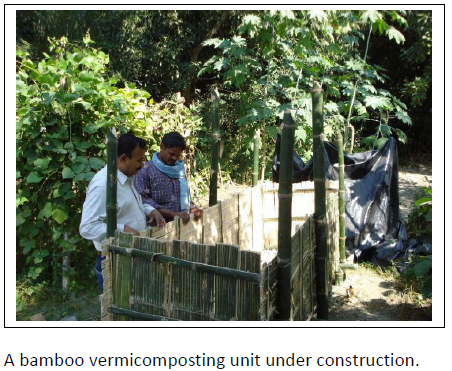
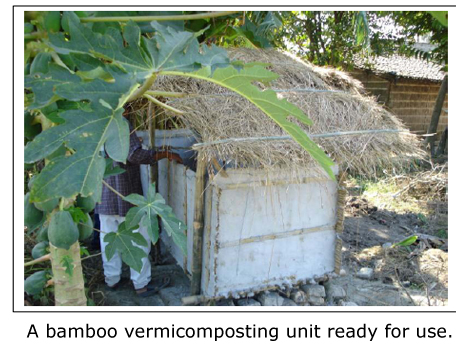
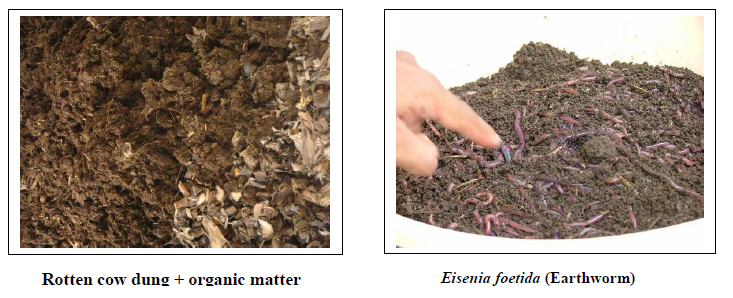
Out of three ecological varieties of earthworms, the epigeics in particular and anecics in general have largely been harnessed for the use in the vermicomposting processes. The vermicomposting is carried out in different types of pits i.e. low cost bamboo pit and concrete pit of 4 m X 1m X 0.75 m size, loaded with partially decomposed (30-45 days) cow dung, organic waste and soil mixture in the ratio of 3:2:1 at optimum temperature (< 35 0C) , moisture (75% w/w) , which will allow for decomposition. Suitable strains of earthworms @1500-2000 worms per cubic meter are inoculated per 100 kg of waste. Earthworms are not disturbed during course of decomposition. To protect from rain and wind, a polythene sheet or temporary shed of about 5 feet height above the ground level is required to cover the pit. Compost becomes ready in 60-80 days.
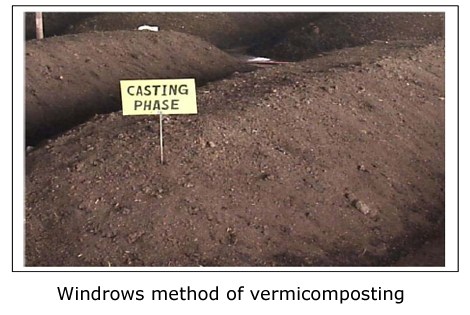
At Rajendra Agricultural University, activities on vermicompost started in the year 2006 at Krishi Vigyan Kendra, Birauli (Samastipur). Since then it has traveled long and now-a-days almost all the KVKs of the Universities are directly or indirectly involved in promotion of this ecofreindly technology. Recently under the dynamic leadership of Vice-Chancellor, Dr. M. L. Choudhary, Department of Soil Science has taken a lead to establish large scale production cum demonstration unit at University Head quarter, where the process of vermicomposting is carried out by different methods i.e. Pit Method, Windrows method, trench method as well as in low cost bamboo pit.
So far, 14 groups each consisting of 20 men and women farmers have been formed in selected villages of Samastipur (Thahra Gopalpur, Bahadurpur, Gokhula, Malpur, Kalwara, Mabbi), Muzaffarpur (Bahuara, Bimalpur, Baburban, Mathina) and Sheohar (Chiknauta, Sundarpur) districts. To acquaint farmers about the proper technology of vermicomposting, group wise two days training programmes were conducted at University headquarters at Pusa.
Formation of Vermicompost Pits
The process of vermicomposting is carried out in different type of pits. But in Pusa cluster, low cost bamboo pit and brick pit of size 4m x 1m x 0.75m has been promoted. Low cost bamboo pit is our innovative idea which costs about Rs. 2450 per pit including labour charges. Following pits have been constructed in various NAIP villages of Samastipur. |